Dear customers,

We will be attending the following exhibitions:

If you are interested in any items from our catalogue and have the opportunity to visit one of the exhibitions, please let us know the item number and your name, and we will bring the goods for you to view in person.
Kind regards, Alex
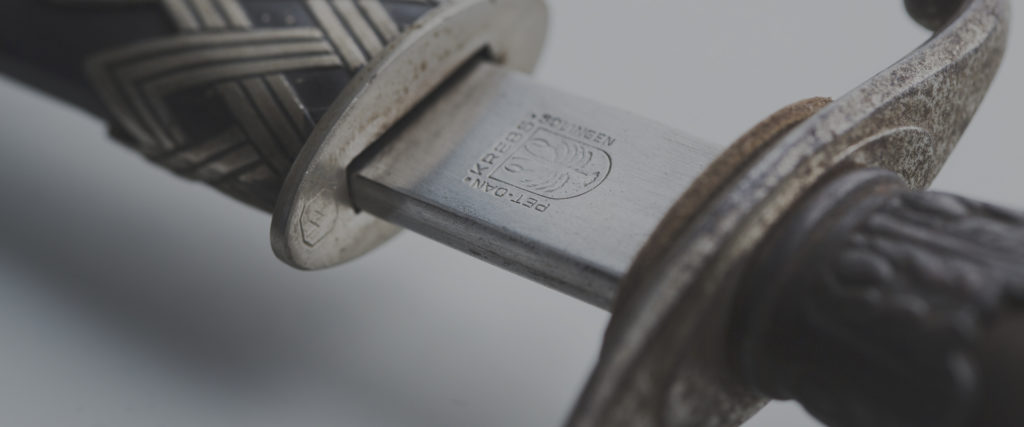
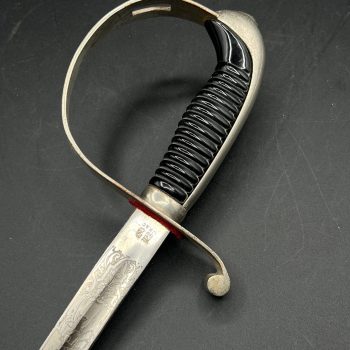
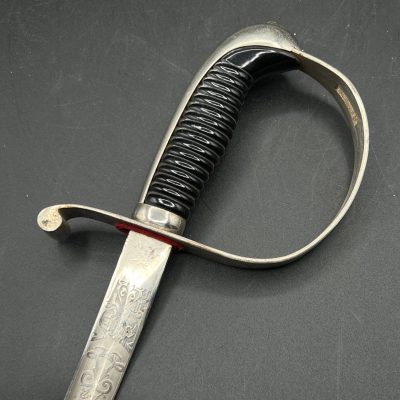
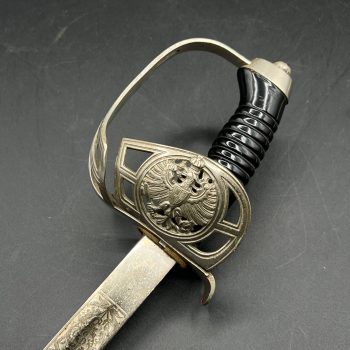
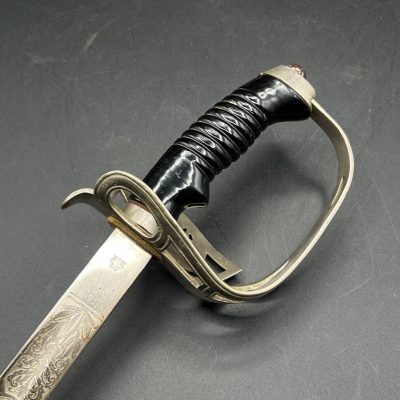
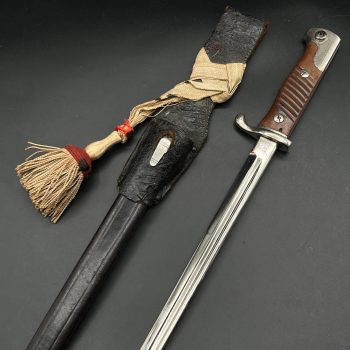
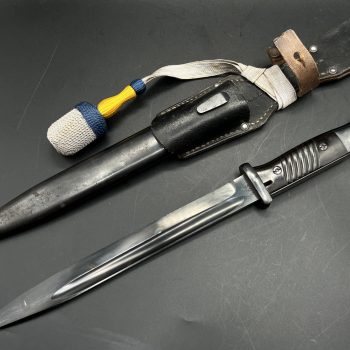
  • POLICE BAYONET Third Reich period emblem, upgraded from the Weimar-era design. [Carl Eickhorn]. (Matching numbers)

    POLICE BAYONET Third Reich period emblem, upgraded from the Weimar-era design. [Carl Eickhorn]. (Matching numbers) (Lot: 1281)

    A police bayonet of the Weimar period, subsequently modified in accordance with Third Reich standards, representing a characteristic example of the unification measures implemented within German police structures after 1933. The blade bears the trademark of the renowned Solingen firm Carl Eickhorn — the squirrel emblem that served as a guarantee of the highest quality from this manufacturer.

    Structurally, the bayonet retains evidence of its Weimar origins: the originally longer blade was shortened, with the point reground to conform to the new standard. The grip was similarly reduced in length. The Weimar-era escutcheon was replaced with a new police emblem — an eagle with swastika within an oak wreath, characteristic of the Third Reich police service. The leather scabbard has likewise been adjusted to accommodate the reduced blade length. Matching numbers are preserved on both blade and scabbard — identical serial designations confirming their factory pairing.

    Police bayonets constituted a distinctive type of edged weapon issued to German police forces during the Weimar Republic and Third Reich periods. Police bayonets differed structurally from military patterns in blade configuration and the characteristic grip treatment featuring the police emblem. Weapons of this type were employed primarily for parade and ceremonial purposes, as well as during guard duty. The modification of Weimar-era bayonets was conducted on a large scale as part of the standardisation of police unit armaments, rendering this category of items relatively common among collectors of German police edged weapons. Many surviving examples display original Weimar-period police unit markings, frequently accompanied by later numbers and stamps added following modification during re-inventory or reissue to different units.

    The Carl Eickhorn company was established in Solingen in 1865 and became one of the largest manufacturers of edged weapons in Germany. The trademark squirrel emblem (Eichhörnchen) served as a guarantee of the highest quality. During the Third Reich period, the firm produced an extensive range of regulation edged weapons: daggers for all branches of service, SA, SS, NPEA, NSFK, and TeNo daggers, as well as dress daggers, sabres, and swords. Carl Eickhorn products are distinguished by superior steel quality and meticulous finishing, and are highly prized by contemporary collectors.

    Starting bid: $ 995
  • Demjansk Shield 1942, Heer Version, on Field-Grey Backing

    Demjansk Shield 1942, Heer Version, on Field-Grey Backing (Lot: 1280)

    Demjansk arm shield in silver-finish metal on original field-grey wool backing, secured with four copper rivets. Obverse: DEMJANSK inscription, date 1942, crossed swords with aircraft, eagle with swastika wreath at top. Reverse shows typical four-rivet attachment to backing pad. One of the rarest and most coveted German campaign shields — awarded to participants in the Demjansk Pocket encirclement battle.

    Starting bid: $ 1,225
  • Two-Place Medal Bar with Iron Cross 2nd Class and Eastern Front Medal. Maker Marks 100 and 88

    Two-Place Medal Bar with Iron Cross 2nd Class and Eastern Front Medal. Maker Marks 100 and 88 (Lot: 1279)

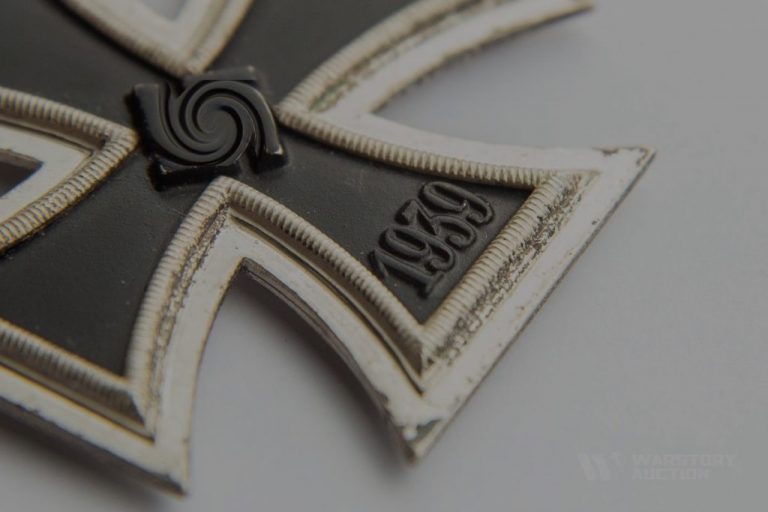
    A two-place medal bar from the Third Reich period, fitted with the Iron Cross 2nd Class 1939 and the Eastern Front Medal 1941/42 (Ostmedaille). The bar features a metal back plate and neatly folded ribbons.
    The suspension ring of the Iron Cross is marked “100”, identifying the maker as Rudolf Wächter, München. The ring of the Eastern Front Medal bears the mark “88”, corresponding to Gustav Brehmer, Markneukirchen.
    Both decorations show honest age patina; the EK2 enamel remains excellent with no damage, and the Ostmedaille retains strong details. Ribbons are vivid and intact. A well-assembled and representative medal bar.

    Starting bid: $ 575
  • SS Long Service Medal, (8 Years), with ribbon

    SS Long Service Medal, (8 Years), with ribbon (Lot: 1278)

    An original SS Long Service Medal, awarded for eight years of faithful service. The piece is struck in bronze with its characteristic matte brown finish. The obverse features a large swastika with a central SS rune wreath, rendered in detailed relief.

    The reverse bears the inscription FÜR TREUE DIENSTE IN DER SS with sharp lettering and an even background. The suspension loop is correctly formed, separately made and soldered—fully consistent with authentic wartime production.

    The medal comes with its original deep-blue ribbon of correct weave, well preserved with no fraying. Overall condition is very good, showing natural patina and crisp details without signs of cleaning or repair.

    Starting bid: $ 1,300